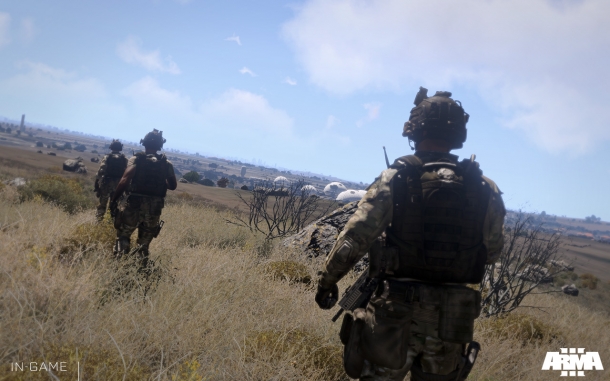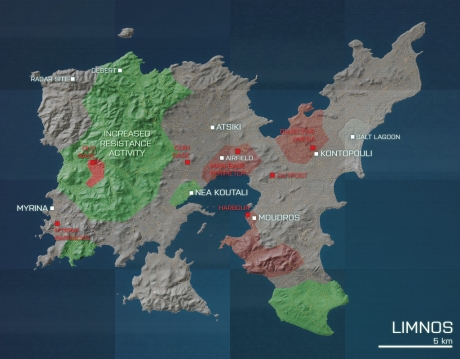
The island of Limnos, once an important Greek air force base in the Mediterranean, is now a remote hostile territory. Still partially inhabited by a fraction of the original Greek populace, the island bears many scars of the fierce battles between Hellenic armed forces and invading Iranian troops in 2033. The large airfield and adjacent military facility now serve as the basis for a fairly large Iranian force supporting a large military compound.
The terrain of its North-Western territory is remarkably hilly, gradually lowering Eastwards into the flatlands; its highest peaks reach almost 400 meters above sea level. The island’s climate is Mediterranean, with particularly strong winds and average temperatures, slightly colder than Greek mainland, mild winters with the occasional seasonal snowfall.
The most inhabited and developed areas can be found on the South-West of the island. The current population (excluding military personnel) is partially scattered amongst the isolated farms and villages, estimated to be approximately 2,000.
The majority of the island is in the hands of hostile forces. Numerous observation posts and checkpoints were rapidly established, many of them in remote parts of the island. Several resistance groups are most probably hiding in the mountainous regions far from the frequently used routes and military outposts. Iranian troops are supplied by air and sea; the base provides power generation, water desalination and other life support.