 Introduction
“Someone call de doctor?”
Witch Doctor is a range intelligence support hero. He is famed for his Death Ward ultimate which deals tremendous burst physical damage to nearby enemy heroes which, if combined with his Maledict ability which amplifies damage taken, can often net him solo kills.
He has traditionally not been picked competitively, but occasionally he is experimented with in the pro scene as he is concerned somewhat underrated and will be picked as a surprise 4th or 5th position support.
You can find Witch Doctor's complete character profile here.
Pros & Cons
Pros
- Really annoying (for enemies) stun
- Good lane sustainability
- Good lane babysitter
- Great damage amplification
- Ultimate deals huge burst physical damage
- Rare case of a support with potentially high damage output and solo kill potential
- Good base movespeed
Cons
- Stun is somewhat unreliable, especially when nearby creeps
- Squishy
- Heal is mana intensive
- Maledict has a very short range and radius which can make it hard to land
- Ultimate is channelled and thus vulnerable to interruption
- No escape mechanism
Item Build
 Witch Doctor is typically played as a lane support, especially in public matchmaking, and so this build guide is geared towards this style of play. In competitive Dota he is rarely chosen at all, and when he is it is typically as a babysit support hero.
Starting Items
As a support hero it’s your job to ensure that the Courier and/or Observer Wards are bought at the start of the game. Usually these duties will be split between yourself and another hero on your team, but you can’t always guarantee this in public games. If no one else ponies up the gold for one then you should bite the bullet and buy both for your team.
Good starting items for Witch Doctor are:
Courier and/or Observer Wards, a Set of Tangos, a Healing Salve, 3x Iron Branches, and as many Clarities as you can afford.
Early Game
Ensure that the Courier is upgraded into a Flying Courier when it comes off cooldown at the 3 minute mark. Also ensure that Observer Wards are always purchased when they’re off cooldown.
Get your Boots of Speed up and running first. Witch Doctor actually has decent base move speed (305), but is still squishy and vulnerable to early rotations and ganks, so Boots are a must.
Upgrade any Iron Branches you have into a Magic Wand, and any Bracer components into a Bracer. The Bracer is optional but highly recommended for some nice early stats and tankability.
Core Items
Arcane Boots are my favourite upgraded boots on Witch Doctor. Most of the default build guides recommend Phase Boots, but I feel they’re unnecessary and don’t really synergise all that well with him. You pick up Phase Boots for superior mobility and increased damage – Witch Doctor neither suffers from poor move speed, nor is he a right-clicker. Instead, he’s very reliant on his abilities, all of which have fairly high mana costs. Additionally, Arcane Boots provide great utility for your team, and will allow you to more easily pull off being the team’s Mekanism carrier.
Talking of which - if there are no more viable Mekanism carriers on your team that will get it up much faster than you (such as a mid-Viper, or a jungle Chen), then Mekanism should be your go-to core item – it’s absolutely necessary for your team. Be sure to check with your team to see if anyone else intends to build one before you get started on it. If someone else does intend to build it then you can move straight onto a luxury item pick-up.
Luxury Items
Drums of Endurance - Drums of Endurance are a great option because they give you team bonus attack speed and move speed auras, whilst at the same time giving you plenty of stats and being easy to build into (since the components are so cheap you can buy them up whenever you have the spare unreliable gold, meaning you won’t lose much gold when you die). You probably already have a Bracer from the early game as well, making Drums a natural extension to your inventory.
Aghanim’s Scepter – The best luxury item to shoot for providing you’re able to get your ultimate off and don’t find yourself stun-locked or burst down when you use it. Aside from a nice chunk of health and experience, Aghanims gives you a significant ultimate buff. It increases the damage from your Death Ward from 60/90/120 to 90/120/150, and crucially it will bounce up to four times, meaning you’ll damage every single hero on the enemy team in major teamfights, unless they move outside of its 700 unit attack range of they stun you.
A full duration attack from Death Ward when Witch Doctor has Aghanims will deal 2880/3840/4800 respectively. With up to 5 heroes capable of being hit that’s an impressive amount of burst physical damage WD is capable of dealing.
Black King Bar – If you do find that your ultimate is almost instantly cancelled because the enemy dedicate a stun to shutting you down, or burst you down with magic damage, then BKB is the route to take. Often BKB is purchased after Aghanims on WD, but sometimes you may need to prioritise it ahead of Aghanims if you find you’re not being given a chance to use your ultimate anyway. A nice chunk of health and spell immunity will make you much harder to shut down when you use your Death Ward.
Necronomicon – Great if you’re part of a pushing line-up or your team is struggling to break the base. Also a great item for teamfights and for countering any invis enemy heroes.
Scythe of Vyse – The ultimate late game item for most intelligence heroes. It's very good on Witch Doctor too, giving you another, more reliable source of disable, although you won't get as much out of the bonus stats as most typical Scythe carriers that can transition into semi-carry roles. The 3.5 second Hex is superb in teamfights and for picking off enemy heroes though. The enormous cost makes it prohibitively expensive for most supports, but if the game is going very late and you're almost 6 slotted it's a great option.
Dagon – An old-fashioned classic on Witch Doctor: Maledict + Dagon + your ultimate hurts. A lot. Generally considered a somewhat trollish/greedy build; it allows you to keep on snowballing if you gain an early lead, but is generally not advised because as a support you should probably be purchasing items that have team-based utility, not solo kill and kill securing potential.
Shadow Blade – Another classic fun build on WD that has generally fallen out of favour because it’s such a greedy option. The idea behind Shadow Blade on Witch Doctor is that you can use Shadow Blade after starting to channel your ultimate, allowing you to hide under the cover of invisibility without breaking the channel on your Death Ward. This forces the enemy supports to always bring detection to teamfights, lest an invisible Witch Doctor is able to channel a full duration ultimate in the middle of the teamfight hotspot.
The downside is it’s a really expensive investment, more suited to a 1-3 position core than a 4-5 position utility/support hero. And since it doesn’t directly provide support for your team (besides forcing enemy supports to spend gold on detection), it’s not a very utilitarian build. It is damn good fun though, especially in lower ranks where invisibility tends to be punished much less frequently.
Force Staff – It’s an amazing escape tool for someone who is naturally very squishy and can be used on allies and enemies, making it a great play-making item for clutch saves or to Force an enemy into bad positioning. It also gives you some stats.
Orchid Malevolence – It gives you a great boost of damage, attack speed, and mana. The added mana and mana regen allow you to use your abilities more liberally and the active 'Soul Burn' will allow you to silence an enemy hero and deal significantly more damage for its duration (combine with Maledict and Death Ward to deal obscene amounts of damage). The other great thing about Orchid is that it's really easy to build into.
Great option if you, as a support/utility hero, are struggling to find a way to deal with highly mobile enemy cores in teamfights.
Situational Items
Sentry Wards, Dust of Appearance, Gem of True Sight – all-important detection. You’ll need at least one of these in your inventory if the enemy line-up features an invis hero. Sentry Wards will also allow you to deward rune spots, and Gem will give you superior vision going into the mid and late game.
Smoke of Deceit – If you roam with another support in the early stages of the game a Smoke will allow you to do so more quickly and without being spotted by enemy wards. Smoke will also come in handy in the post-laning phase if your team wants to gank as 5.
Pipe of Insight – If you didn't buy the team's Mekanism earlier on then consider getting a Pipe as a luxury item for your team. If you did buy the Mekanism then it's very risky getting Pipe as well - it's inadvisable to have both on one hero, doubly so when that hero is as squishy as WD.
Boots of Travel – Great for the late game, when you need to free up a slot which would otherwise be taken up by a TP Scroll. With this, you combine your Boots and TP Scroll slot into one, allowing you to put a slot to better use if you’re about to become 6 slotted (which will be highly unlikely on WD!).
Vladmir’s Offering - Yes, you’re ranged, so you won’t get the lifesteal bonus from Vlad’s, but you’re not buying it for yourself, you’re buying it for your team. Vladmir’s Offering is great to pick up on a support even if your team doesn’t consist of any melee heroes because of the bonus damage and armour it provides. If your team does have a melee core and no one else has purchased one then it’s an excellent utility item to purchase.
Skill Build
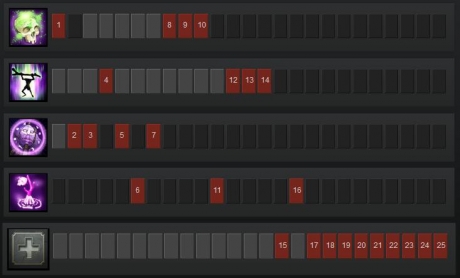 Paralyzing Cask is always skilled first and typically maxed second. Witch Doctor’s only form of disable, Cask stuns the chosen target for 1 second while it bounces to other targets. Each target it hits is stun for a second and dealt damage. Additional levels increases the damage dealt, increases the number of ‘bounces’, increases the mana cost, and decreases the cooldown. The damage is minimal, but the stun can be very annoying to deal with if you happen to be on the opposing team.
It is chiefly skilled in order to gain additional bounces, the hope being that the Cask will bounce between enemy heroes several times in succession, effectively ensuring the stun duration is in practice much longer than just 1 second. The downside is that the bounces are RNG based, and can just as easily avoid hitting any enemy heroes beyond the initial target if cast near a creep wave or neutral camp.
Voodoo Restoration is usually skilled and maxed last. It is a healing ability that heals allies in a 500 unit radius for 16/24/32/40 health per second. It has no cooldown, and so can in theory be used indefinitely. In practice its mana cost makes doing so prohibitive – it costs an initial 20/30/40/50 mana to use and then an additional 8/12/16/20 mana per second for as long as it’s used.
I like to take an early point in Voodoo Restoration in order to provide some extra health regeneration for both myself and the allied core hero I’m likely babysitting in the lane. It reduces the pressure on your consumables and the need to ship more out. The mana cost also isn’t too bad at level 1, but quickly ramps up if you choose to skill it more than once. For this reason I skill it last, so that I’m able to use it much more freely without it being a huge drain on my mana pool early on.
Maledict is a damage amplification ability, and one of the most powerful non-ultimate abilities in the game, providing the enemy is targeted with some follow up damage. I like to skill this second but I always max it first because it is just so incredibly potent.
It has a small radius of just 180 units, but any enemy units caught within this radius will take a small amount of damage per second for the following 12 seconds and, crucially, will take an additional 16/24/32/40 damage per 100 health they lose during those 12 seconds. Deal 1000 health of damage to the enemy in those 12 seconds, then, and you’ll deal an extra 160/240/320/400 on top of the ability’s default damage of 60/120/180/320.
Death Ward is always skilled (levels 6, 11 and 16). Another fearsome damage ability, this allows Witch Doctor to channel a Death Ward for 8 seconds. The Death Ward has an attack range of 700 units and deals 60/90/120 physical damage to an enemy hero within its range every 0.22 seconds. Between this and Maledict WD’s damage output and solo kill potential is actually very high, and often under-estimated by enemies who see you as ‘just a support’.
Once you manage to hit level 16 the Death Ward will bounce to a second target (or 4 targets if you have Aghanim’s Scepter by then). The only downside of Death Ward is that it has a somewhat limited cast range of 600 units, so Witch Doctor will often need to be fairly close to the main engagement when he uses it. Since it’s a channelled ability, this makes him highly vulnerable to it being interrupted by stuns (or death). The Ward is also static, so if enemies simply retreat from the area you’ll find it largely a wasted opportunity.
Gameplay Tips
 Paralyzing Cask is considerably better if cast in the middle of the chaos of a teamfight where there are no enemy or neutral creeps present. So long as the enemy heroes remain within 575 units of one another all 2/4/6/8 bounces will connect with enemy heroes, dealing essentially 8 seconds worth of stun and 800/1200/1600/2000. Naturally it’s quite rare to achieve this perfect combination, but the less creeps there are and the more enemy heroes there are, the more effective Cask will be.
Between Cask and Voodoo Restoration WD is actually a good pusher. Cask will help clear creep waves whilst Voodoo Restoration will give your party good health regeneration and thus increase your push’s sustainability.
Voodoo Restoration is great at level 1 once you get Arcane Boots or some other source of reliable mana regeneration and a more substantial mana pool. During pushes and teamfights you can have it activated almost continuously in order to give nearby allied units (and yourself) a nice infusion of health regeneration.
Maledict’s damage amplification capability is incredible. Be sure to try and cast it on an enemy core or multiple enemies in teamfights. The cast range is small (525 units), but if you manage to successfully cast it they will not be able to fight into your team.
Maledict makes Death Ward incredibly more potent. Whenever possible try to ensure an enemy hero is affected by Maledict before using your ultimate; Death Ward without Maledict is not nearly as scary.
| Tip: Not many people seem to realise that you can control the Death Ward and determine which hero (if there are multiple ones in range) is targeted. Use it to attack either enemy heroes with Maledict on them, those on already low-life, or squishy heroes. |
Your bread and butter combo for a solo kill is: Paralyzing Cask > cast Maledict whilst hero is stunned > use Death Ward. No hero will be able to stand and take the hits from a Death Ward whilst they have Maledict on them, so unless they have a stun with which to interrupt your channeling they will have to make a hasty retreat. The goal is to deal sufficient damage while they are in range that they will ‘pop’ from the Maledict ticks some time over the 12 seconds of its duration.
| Tip: If you find your ultimate is prone to being cancelled by the enemy team, attempt to cast it from the cover of fog of war, for example by casting it from behind a treeline or from the high ground down to a choke point. The cast range is fairly short, at 600 units, but that’s still a typical ranged unit’s attack range for context. |
Black King Bar is a high priority luxury item on Witch Doctor because his ultimate is both incredibly powerful and highly vulnerable to interruption. Once you have a Black King Bar you can cast it before you lay the Death Ward down in order to prevent most stuns or disables from being able to interrupt you.
| Note: Death Ward deals physical damage, which means it goes through Black King Bar. Use this knowledge to your advantage and don’t be put off casting it on BKB’d enemy heroes. |
Last Updated - Patch 6.82.